
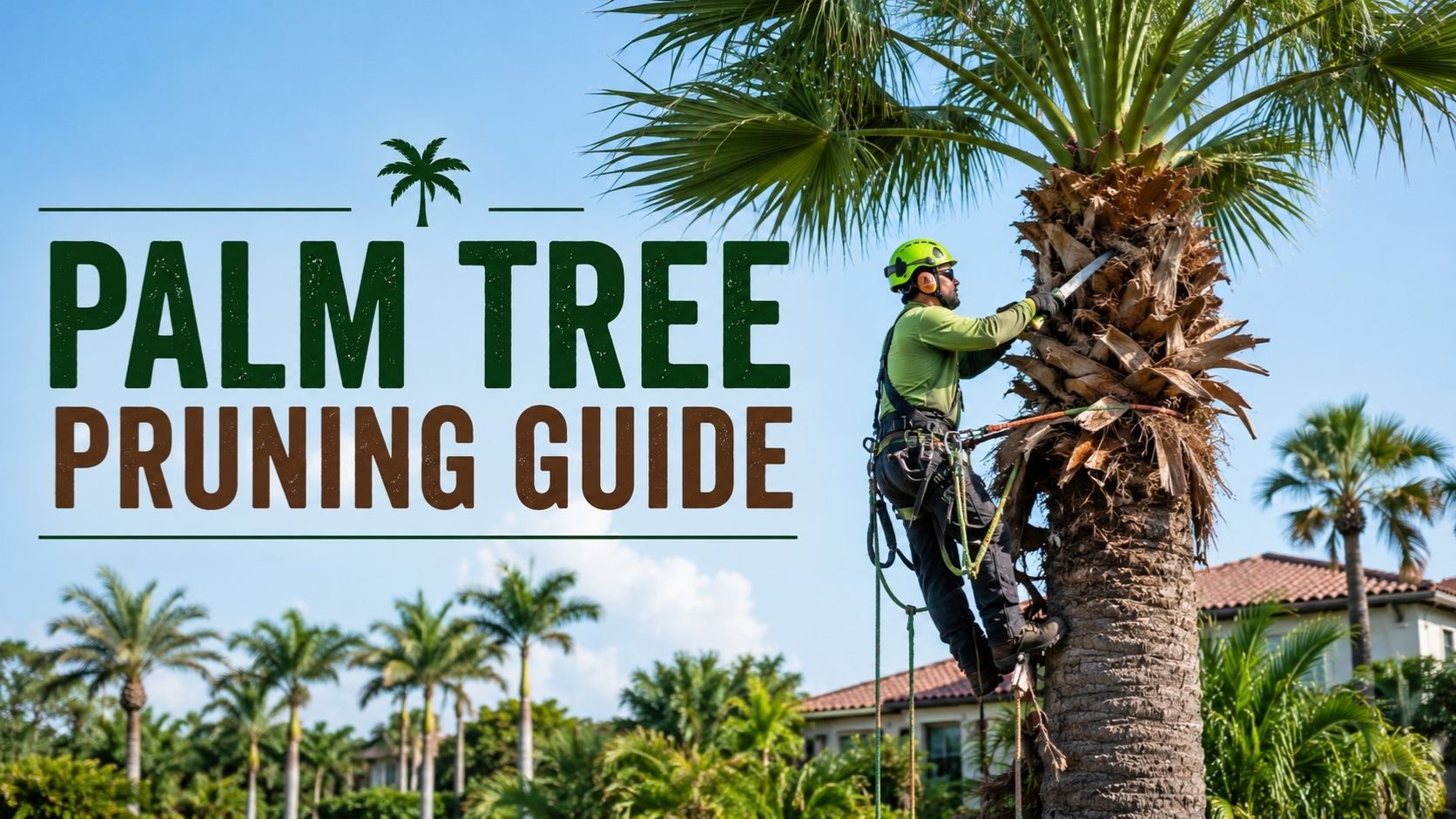
Palm trees can instantly improve a property’s appearance, but pruning them incorrectly can permanently damage them. Whether you are handling basic maintenance yourself or hiring a professional palm tree pruning service, understanding the right timing, tools, and techniques is essential.
Palm pruning is common across Florida, California, Texas, Arizona, and Hawaii, where palms are a major part of the residential and commercial landscape. The core pruning principles remain the same regardless of location, though timing can vary slightly by climate zone.
Why Palm Tree Pruning Matters More Than You Think
Palms are not like your average deciduous tree. They do not compartmentalize wounds the way oaks or maples do. When you make a cut on a palm, even a bad one, that wound is permanent. The tree does not grow over it. That is why proper pruning matters so much.
If you are new to tree care in general, our guide on why regular tree pruning is essential for healthy trees covers the broader principles that apply across all species.
Done correctly, palm tree pruning delivers real benefits:
- Preserves tree health by removing dead weight, which the tree is wasting energy on
- Improves curb appeal and keeps your property looking sharp
- Eliminates hiding spots for rodents, insects, and other pests in dead frond skirts
- Reduces wind resistance, which is critical in storm-prone regions like Florida and the Gulf Coast
- Removes fire hazards, since dry palm fronds are highly flammable
- Prevents falling fronds and heavy fruit clusters from becoming safety hazards
Done wrong, pruning can permanently stunt your palm’s growth, expose it to disease, weaken its structure, and in extreme cases, kill it. Improper pruning can create long-term problems that are difficult or impossible to reverse.
Do All Palm Trees Actually Need to Be Pruned?
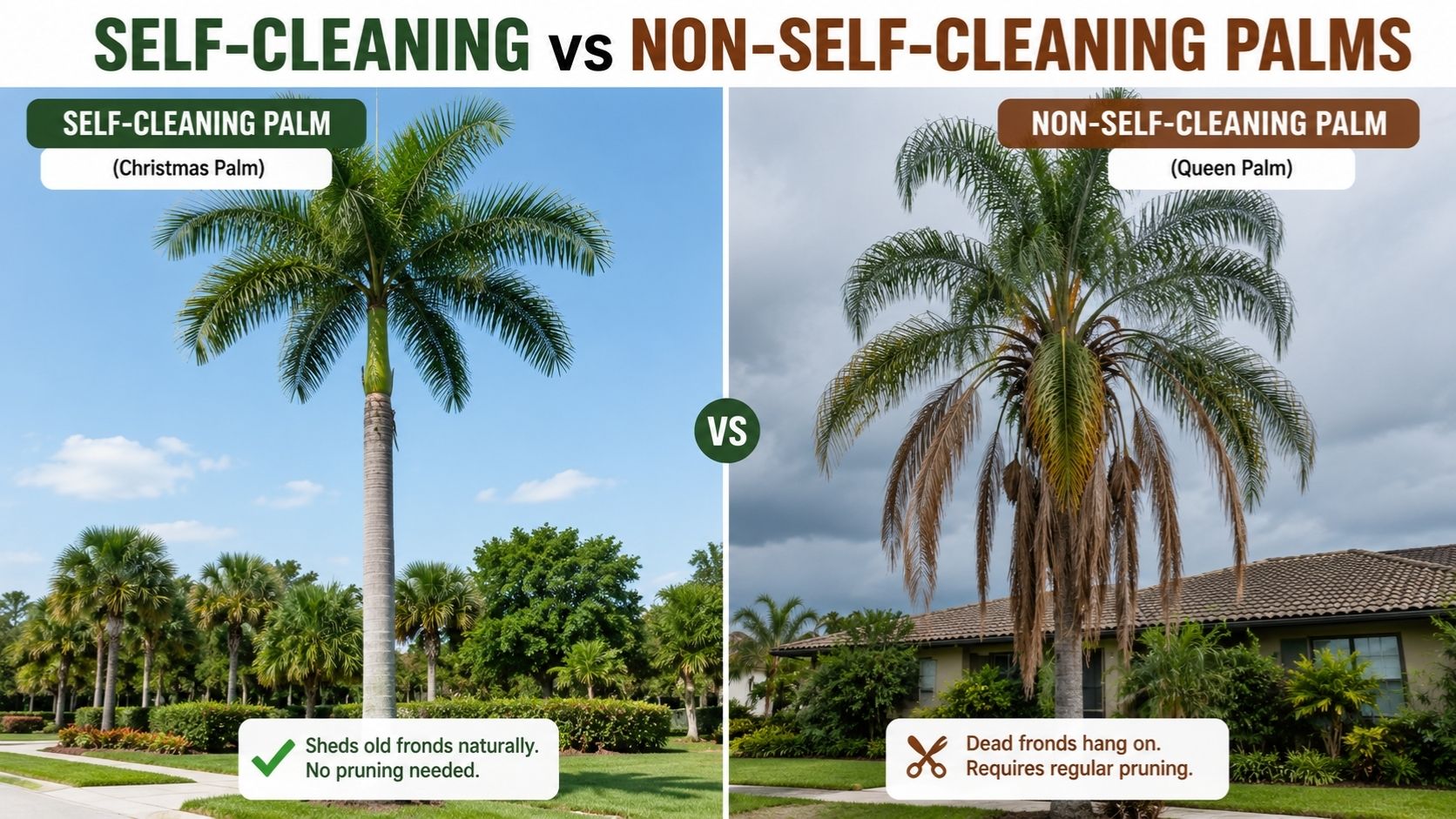
Not every palm needs your help. Some palms are self-cleaning, meaning dead fronds naturally detach and drop on their own without any intervention. If you own one of these species, the best thing you can do is step back and leave it alone.
Self-cleaning palms include the following:
- Christmas Palm (Adonidia merrillii)
- Royal Palm (Roystonea regia)
- Chinese Fan Palm (Livistona chinensis)
If you have a queen palm, date palm, sabal palmetto, or windmill palm, you will need to prune them periodically. The rest of this guide is for you.
The #1 Mistake: Over-Pruning (Hurricane Cutting)
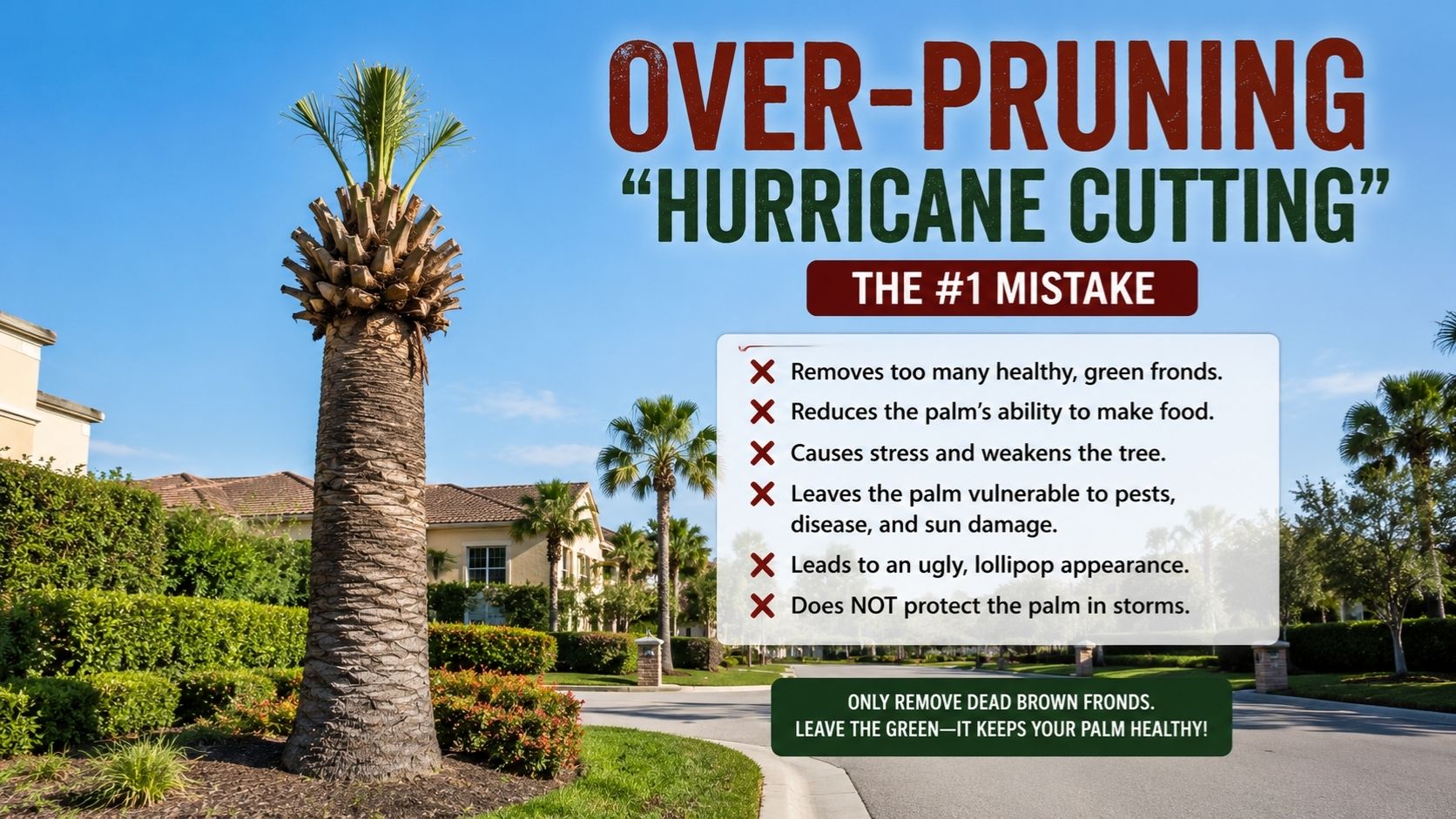
Walk through any neighborhood with palms, and you will see it: trees shaved down to just a tiny cluster of fronds at the top, looking more like a lollipop on a stick than a healthy tree. In the industry, this is called “hurricane cutting” or “lion-tailing,” and it is one of the worst things you can do to a palm.
Every green frond plays an important role in producing the energy the palm needs to survive and grow. Through photosynthesis, those leaves produce the sugars the tree needs to grow, defend itself from disease, and push out new growth. When you strip them away, the palm is forced to raid its internal nutrient reserves just to survive. The tree goes into stress mode. To understand the full range of damage chronic stress causes in trees, see our breakdown of the most common reasons trees die.
Over-pruning causes:
- Nutritional deficiencies that show up as yellowing in new growth
- “Pencil-pointing”: the trunk narrows at the top because the tree cannot sustain normal girth
- Increased vulnerability to pests and fungal infections
- Exposure of the apical meristem (the growing bud at the top), which, if damaged, means the palm is dead
- Greater wind-throw risk, not less. A full canopy actually helps the tree flex and absorb wind
The rule is simple: only remove fronds that are completely brown and dead. If there is any green left in a frond, even at the base, leave it alone. Never remove more than the dead fronds plus the flower stalks in a single pruning session.
When Is the Best Time for Palm Tree Pruning?
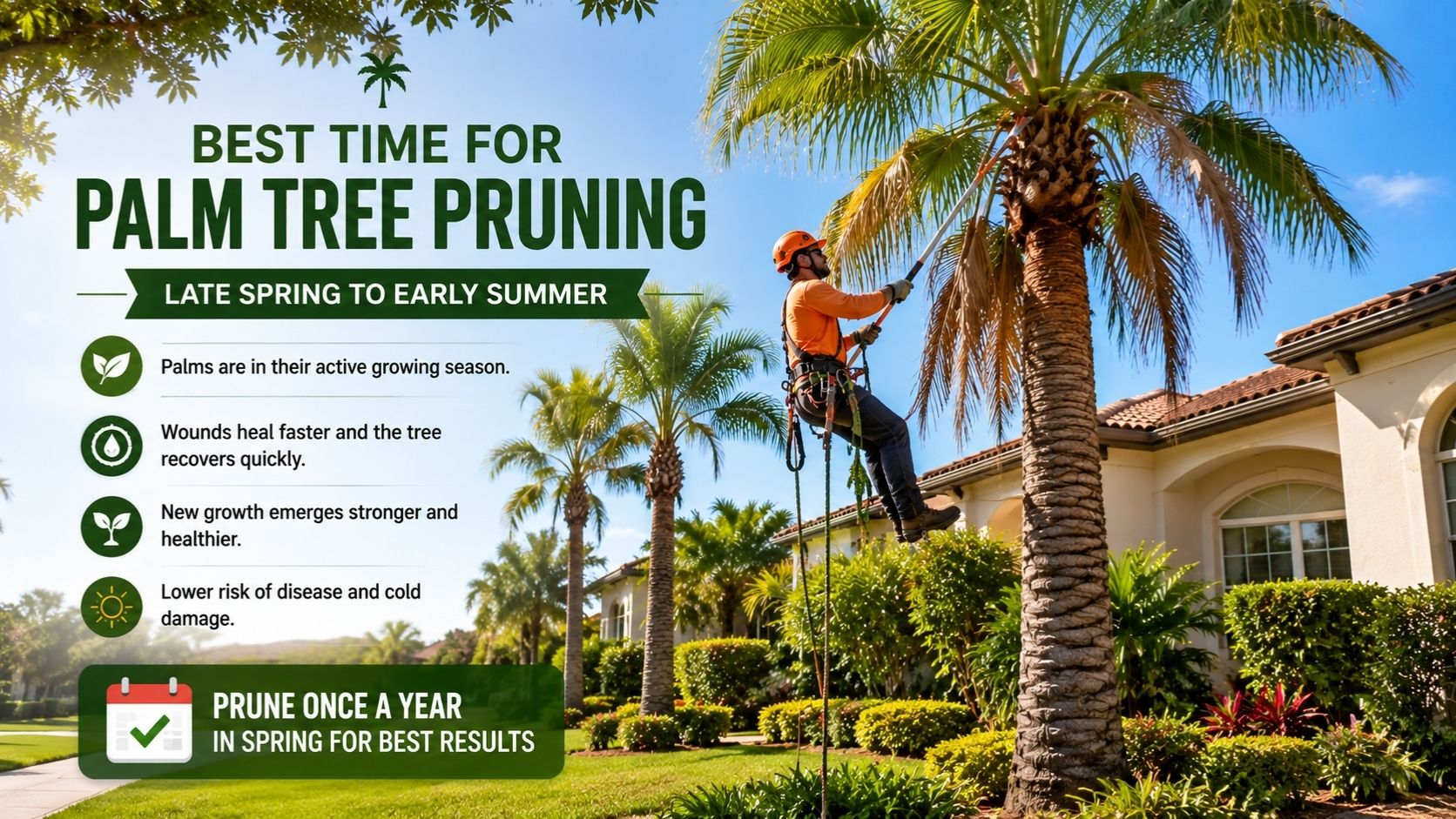
Timing your pruning correctly makes a significant difference in how quickly your tree recovers and how resistant it is to stress.
Late Spring to Early Summer: The Sweet Spot
For most palm species, late spring through early summer is ideal. The tree is entering its active growing season, which means it has plenty of energy to recover quickly. Wounds seal up faster, and the tree pushes out new growth to replace what was removed.
When to Prune Queen Palm Trees
Queen palms (Syagrus romanzoffiana) are heavy fruit producers, and their seed pods can be a serious mess and a hazard. For these trees, prune flower stalks before they develop into fruit clusters. Early spring, before fruiting begins, is the right window.
When to Prune Sabal Palms and Windmill Palms
Sabal palmettos and windmill palms are among the toughest and most cold-tolerant palms available. They are low-maintenance and generally only need pruning once a year. Stick to late spring and avoid any pruning in fall or early winter, as those cold months can cause cut surfaces to dry and crack, increasing disease risk.
Avoid Fall and Winter Pruning
Pruning in the colder months strips away the insulating frond coverage that protects the trunk and growing bud from frost. In borderline climate zones such as North Florida, Georgia’s coastal areas, or parts of inland California, this can be the difference between a tree that survives a cold snap and one that does not. Unless a frond is actively creating a hazard, leave winter pruning alone.
General rule: prune once per year, in spring. Anything more frequent than that and you are pushing your palm toward chronic stress.
Palm Tree Pruning Tools: What You Actually Need
Using the right tools is about safety and tree health, not just efficiency. Dull or dirty tools tear tissue rather than cut it cleanly, leaving ragged wounds that take longer to seal and create entry points for pathogens.
| Tool | Best For | What to Look For |
| Pruning Shears | Small fronds and flower stalks on shorter, younger palms | Bypass-style blades with hardened steel for clean, low-damage cuts |
| Pruning Loppers | Frond bases too thick for shears | Long handles for leverage and more control than a saw on mid-size growth |
| Telescoping Pole Saw | Reaching fronds on tall palms without a ladder | Curved blade, adjustable angle head, 10-16 ft reach |
| Palm Pruning Hand Saw | Cutting close to the trunk where precision matters | Serrated, curved blade for control near the boot without damaging trunk tissue |
| Heavy-Duty Ladder | Palms that exceed your pole saw’s reach | Fiberglass or aluminum; always work with a second person at height |
| Heavy Gloves | All palm species, especially pygmy date palms | Thick leather to protect against razor-sharp spines at frond bases |
| Safety Glasses | Every pruning job | Non-negotiable: debris falls with every cut |
| Disinfectant | Between every tree, before and after each job | Rubbing alcohol or diluted bleach (1 part bleach to 9 parts water) |
Do not allow any contractor to climb your palm with spiked shoes (climbing spikes). Those spikes punch dozens of holes in the trunk that become pathways for insects, bacteria, and fungi. Any reputable service will use a ladder or bucket truck instead.
How to Prune a Palm Tree: Step-by-Step
Step 1: Assess Before You Cut
Walk around the tree and look at it from multiple angles before you pick up a single tool. Identify which fronds are completely dead (fully brown, no green remaining), which are yellowing but still alive, and whether there are any flower stalks or fruit clusters that need removal. Make a plan before you start cutting. If you are unsure whether what you are seeing is normal aging or something more serious, check our guide on signs your tree is dying before you proceed.
Step 2: Disinfect Your Tools
Wipe blades down with rubbing alcohol or a diluted bleach solution (1 part bleach to 9 parts water). Let them air dry for 30 seconds before cutting. This step costs two minutes and can save your tree.
Step 3: Start from the Bottom, Work Up
Begin pruning below the canopy and work upward. Only remove fronds that hang below the horizontal. The classic reference point is the 9-and-3 position on a clock face. Fronds pointing downward are past their useful life. Fronds that are still horizontal or angled upward are still working for the tree.
Step 4: Cut Correctly
For smaller palms like pygmy date palms (Phoenix roebelinii), leave about 1/2 to 3/4 inch of the frond base attached to the trunk. For large palms, leave 4-6 inches. Do not flush-cut right against the trunk, as you will damage the trunk tissue. Do not leave long stubs either, as they become pest habitat. The remaining stub (called the boot) will dry, die, and eventually fall off on its own in most species.
Step 5: Remove Flower Stalks and Fruit Clusters
After handling the dead fronds, move to any inflorescence (flower stalks) and fruit clusters. These take significant energy for the palm to produce and maintain. Removing them redirects that energy to growth and root development. It also prevents the hazard of heavy fruit dropping and the pest and odor problems that come with rotting fruit on the ground.
Step 6: Clean Up and Re-Disinfect
Collect all removed fronds and dispose of them properly. Do not leave a pile around the base of the tree, as this creates pest habitat. Re-clean your tools before putting them away, especially if you are moving to another tree.
Pruning Different Palm Species: What You Need to Know
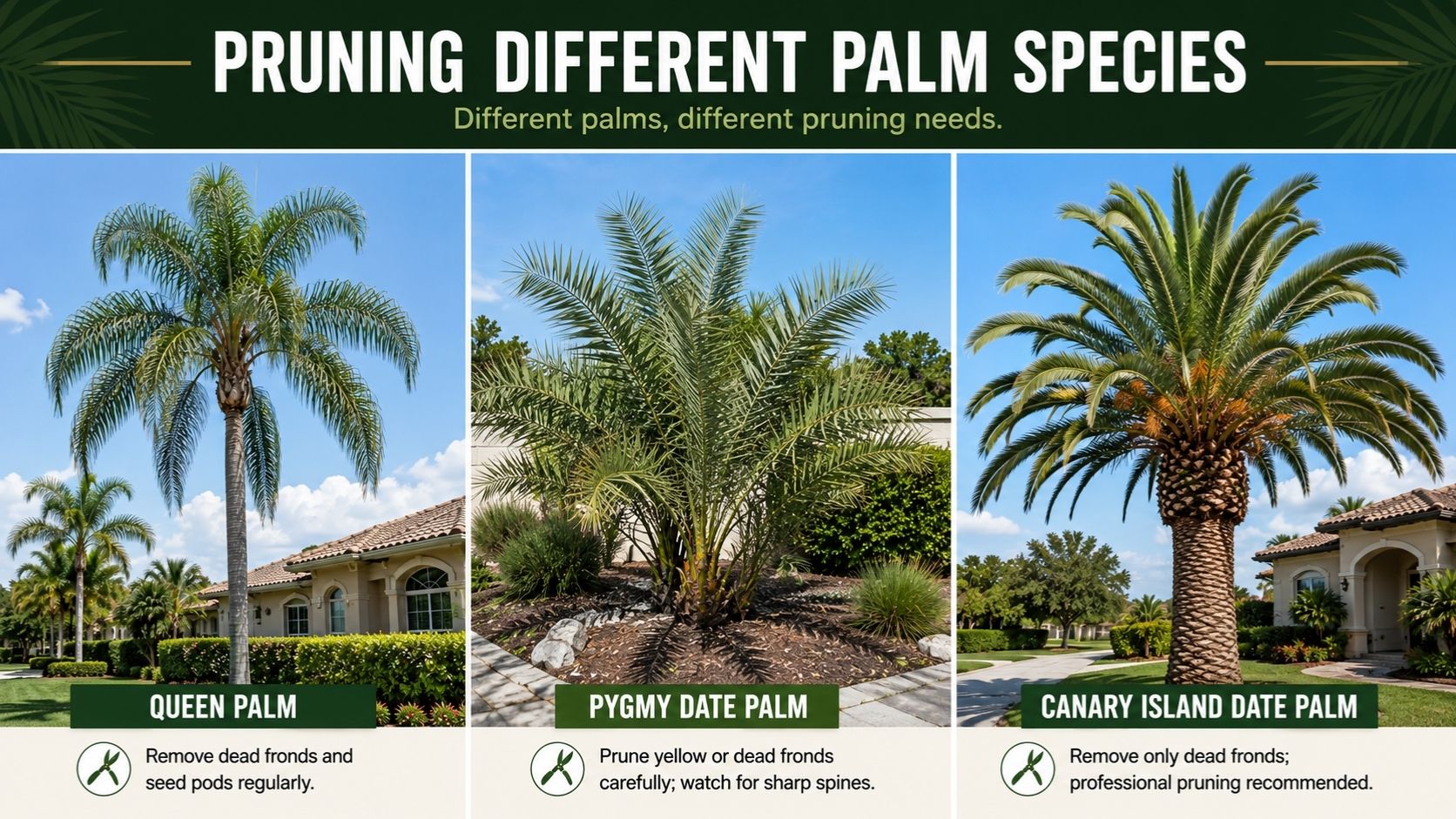
Pruning Queen Palm Trees
Queen palms are gorgeous but messy. The seed pods drop constantly and attract pests. For these trees, prioritize removing old flower stalks before they develop fruit. Remove dead fronds as you go. Queen palms are also susceptible to Ganoderma butt rot, a fatal fungal disease. Keeping tool sanitation tight is especially critical here, and knowing how to spot disease early can save the tree. Learn how to identify early disease symptoms before they become irreversible.
Pygmy Date Palm Pruning
Pygmy date palms (Phoenix roebelinii) are elegant, multi-stemmed small palms, and their frond bases are covered in needle-sharp spines. Wear thick leather gloves and long sleeves. Cut frond bases 1/2 to 3/4 inch from the trunk. Remove dead fronds and damaged ones, but be conservative, as these smaller trees have fewer fronds to spare.
Canary Island Date Palm
These are large, statement trees that require professional equipment and should generally be pruned by certified arborists. The spines on Canary Island date palms are extremely aggressive, and puncture wounds from them can become infected. The same conservative pruning rules apply: dead fronds only, no more than necessary.
Common Palm Tree Pruning Mistakes (And How to Avoid Them)
- Pruning yellowing fronds: Yellow does not mean dead. A yellowing frond is still photosynthesizing and pulling potassium back into the tree before it dies, a process called nutrient remobilization. Cutting it off prematurely robs the tree of that nutrition.
- Cutting too close to the trunk: Flush cuts wound the trunk tissue directly and remove the protective bark layer before it is ready. Always leave an appropriate stub.
- Using dirty tools: This is how Texas Phoenix Palm Decline, Fusarium wilt, and Ganoderma butt rot spread from property to property. Disinfect every single time.
- Pruning in the wrong season: Fall and winter pruning exposes cut surfaces to cold damage and removes the frond coverage that insulates the tree through cold snaps.
- Letting a contractor use climbing spikes: Spiked shoes create dozens of trunk wounds per climb. These are biological entry points for disease, not cosmetic damage. Refuse this practice every time.
- Pruning too frequently: Once a year is the correct frequency for most palms. More than that, you are not giving the tree time to recover and rebuild its canopy.
DIY vs. Professional Palm Tree Pruning Service
Should you prune your own palms or hire a palm tree pruning company near you? The honest answer depends on tree size and your comfort level working at height.
| DIY Palm Tree Pruning | Hire a Professional Palm Tree Pruning Service |
| Palm is under 15 feet tall | The tree is over 20 feet tall |
| You have shears, loppers, and a telescoping pole saw | You own a Canary Island date palm or a large species with aggressive spines |
| The job is dead frond removal only with no structural work | Crown cleaning is needed near power lines or structures |
| You are comfortable using a stable ladder safely | You are unsure whether what you see is dead fronds or a disease symptom |
| One tree or a small number on flat, accessible ground | You want a professional diamond cut finish on a Sylvester date palm |
When searching for a palm tree pruning company near you, ask for proof of insurance and references and confirm upfront that they will not use climbing spikes. Get at least two quotes and be skeptical of anyone who says you need major pruning more than once a year. Learn what separates a qualified professional from a hack in our guide on what a certified arborist does and why it matters.
Final Thoughts:
The most important takeaway from this guide is also the simplest: palms need less pruning than most people think. A palm that is properly fed, watered, and left with a full, healthy canopy will always outperform one that has been over-pruned and left to struggle.
Prune once a year, in spring. Remove only what is dead. Use clean, sharp tools. Protect the growing bud at all costs. And if you are not sure what to cut, what disease you are looking at, or whether a tree is safe to climb, consulting professionals like Tree Amigos Tree Service can help you avoid costly mistakes. The cost of a professional consultation is nothing compared to losing a mature palm you have spent years growing.
Your palms are a long-term investment in your property’s beauty and value. Treat them that way.
Frequently Asked Questions
How often should I prune my palm tree?
For most palm species, once a year in late spring is sufficient. Palms that produce heavy seed pods, such as queen palms, may benefit from having flower stalks removed early in spring as well. Pruning more than twice a year is almost always unnecessary and can stress the tree.
What is the difference between palm tree pruning and palm tree trimming?
Pruning and trimming are often used interchangeably for palms. Technically, pruning involves the selective removal of dead or diseased growth to improve health, while trimming focuses more on shaping and aesthetics. In practice, most palm maintenance jobs involve both: removing dead fronds (pruning) and tidying up seed pods and stubs (trimming). For a deeper breakdown, read our full comparison of tree trimming vs. tree pruning.
Can I prune my palm tree myself?
Yes, for palms under 15 feet tall with a stable ladder and the right tools. For palms over 20 feet, or species with aggressive spines like Canary Island date palms, hiring a certified arborist or licensed tree service is strongly recommended.
What happens if I cut the top of a palm tree?
Cutting the growing tip (apical meristem) at the top of a palm tree will kill it. Unlike most trees, palms have only one growing point and cannot regenerate from it if it is destroyed. Never cut the top of a palm under any circumstances.
Why are my palm fronds turning yellow?
Yellowing fronds are most commonly caused by nutritional deficiencies, particularly potassium or magnesium. They can also signal overwatering, poor drainage, or early-stage disease such as Texas Phoenix Palm Decline or Fusarium wilt. Proper fertilization plays a major role in keeping fronds green and strong. Our guide on tree fertilization timing and methods explains what palms need and when to apply it. If yellowing is progressing upward through the canopy, consult a certified arborist, as some causes are fatal without early treatment.
Can over-pruned palm trees recover?
Palm trees can recover from mild over-pruning over time, but severe hurricane cutting can weaken the tree for years. Repeated over-pruning may permanently reduce canopy growth and increase vulnerability to disease and nutrient deficiencies.