
You plant an acorn. You water it. You wait. And wait. And then one day, decades later, you’re sitting under a canopy so wide it cools your entire yard, and you realize this was worth every single year.
Oak trees don’t grow fast. But nothing they do is accidental. Every inch of height, every new ring of wood, every spreading branch is built to last centuries. If you’re planning to plant one or you already have one in your yard, understanding how long oak trees take to grow helps you set the right expectations and give your tree exactly what it needs at every stage.
Here’s everything you need to know.
How Long Does It Take for an Oak Tree to Grow?
On average, an oak tree takes 20 to 50 years to reach meaningful maturity, and 50 to 100+ years to grow into the towering giant most people picture when they think of an oak.
Here’s a quick overview by milestone:
- Sprout to sapling (1–5 years): 1 to 10 feet tall
- Young tree (5–15 years): 15 to 35 feet tall
- Shade-giving tree (15–30 years): 30 to 50 feet tall
- Fully mature oak (50–100 years): 40 to 100+ feet tall
This may sound like a long time, and it is. But oaks don’t just grow; they build something permanent. Every decade adds dense, storm-resistant wood and an expanding canopy that serves wildlife, cools your landscape, and increases property value for generations.
How Fast Do Oak Trees Grow?
The oak tree growth rate is generally classified as slow to moderate. Most species add 1 to 3 feet of height per year during their peak growth phase, typically ages 5 to 15.
Here’s what to expect by growth phase:
| Growth Phase | Timeline | Growth Details |
| Year 1 | First Growing Season | An acorn germinates in 4–6 weeks under the right conditions and produces a sprout of 6–12 inches by the end of the first season. Growth is focused mainly on root development. |
| Years 2–5 | Early Growth Stage | Above-ground growth increases to 1–2 feet per year. By year 5, the tree may reach 5–10 feet tall with a well-established root system. |
| Years 6–15 | Fastest Growth Phase | Oaks experience their fastest growth, adding 2–3 feet of height annually in ideal conditions. By age 15, many species reach 20–35 feet tall. |
| Years 15–50 | Mature Growth Stage | Growth slows to 1–2 feet per year, while the canopy expands significantly. The trunk thickens and branches extend, giving the tree its mature appearance. |
| Age 50+ | Mature to Old Age | Height growth largely plateaus, but the tree continues to fill out, strengthen its structure, and age gracefully for many decades or even centuries. |
How Fast Do Oak Trees Grow in Texas?
Texas’s long growing season works in your favor, and most well-adapted oaks push 2 to 3 feet per year during their peak years.
The biggest obstacle is clay-heavy soil common across San Antonio and Austin. It restricts roots, limits drainage, and directly slows growth. Deep watering, heavy mulching, and proper soil prep at planting make the biggest difference.
Best performers in Texas:
- Shumard Oak: fastest growing, handles heat and alkaline soil well
- Live Oak: moderate growth, exceptional drought resistance once established
For faster canopy coverage while your oak matures, faster-growing landscape trees are worth planting alongside it.
Oak Species Growth Rate Comparison
Not all oaks grow at the same pace. Here’s a quick reference for the most commonly planted species:
| Oak Species | Growth Rate | Mature Height |
|---|---|---|
| Live Oak | Moderate | 40 to 80 ft |
| Shumard Oak | Fast | 40 to 60 ft |
| White Oak | Slow | 80 to 100 ft |
| Red Oak | Moderate to Fast | 60 to 75 ft |
If you are planting for shade and want results within 10 to 15 years, Shumard or Red Oak are your best starting points. If you are planting a legacy tree and are willing to wait for something truly spectacular, White Oak is in a class of its own.
How Tall Can Oak Trees Grow?
Most oak trees reach between 40 and 100 feet at full maturity, with some exceptional specimens exceeding that under ideal conditions.
Here’s a species-by-species breakdown:
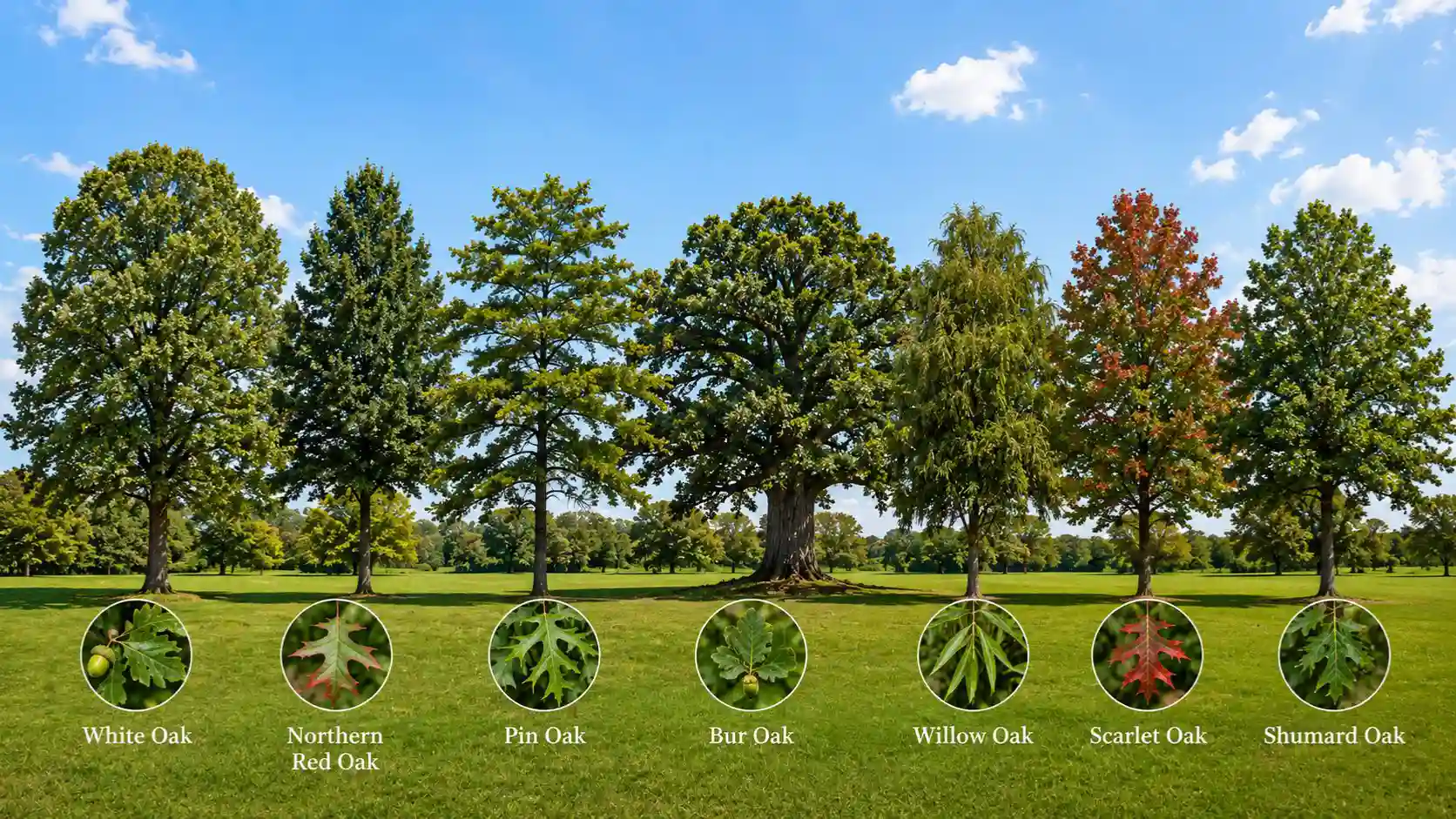
- White Oak (Quercus alba): According to Iowa State University Extension, white oak commonly attains a height of 80 to 100 feet and grows approximately 1 foot per year, slow-growing but extraordinarily long-lived.
- Northern Red Oak (Quercus rubra): 60 to 75 feet. One of the faster-growing oaks, capable of up to 2 feet per year, is known for vivid fall foliage.
- Pin Oak (Quercus palustris): 60 to 70 feet. Adapts well to urban environments. According to Penn State Extension, pin oak performs best in soils with a pH of 5.0 to 7.0. Outside that range, iron chlorosis and declining health become real risks.
- Bur Oak (Quercus macrocarpa): 70 to 80 feet, with a massive trunk and extreme drought tolerance.
- Willow Oak (Quercus phellos): 40 to 75 feet. Narrower and more graceful than other oaks.
- Scarlet Oak (Quercus coccinea): 70 to 75 feet. Brilliant red fall color and moderately fast growth.
- Shumard Oak (Quercus shumardii): 40 to 60 feet. Research from the USDA Forest Service found that Shumard oak showed good survival and growth even when planted on high-pH soils (7.8 to 8.0), making it one of the more adaptable species for challenging sites.
How Tall Do Oak Trees Get? (Year-by-Year Expectations)
| Age | Approximate Height |
|---|---|
| 1 year | 0.5 to 1 foot |
| 5 years | 5 to 10 feet |
| 10 years | 10 to 20 feet |
| 20 years | 20 to 35 feet |
| 30 years | 30 to 50 feet |
| 50 years | 40 to 65 feet |
| 100 years | 60 to 100 feet |
Keep in mind these are averages. A tree planted in compacted, poor, or clay-heavy soil can fall significantly short of these numbers, while one planted in loamy, well-drained soil with full sun may exceed them.
Oak Tree Growth Stages Explained
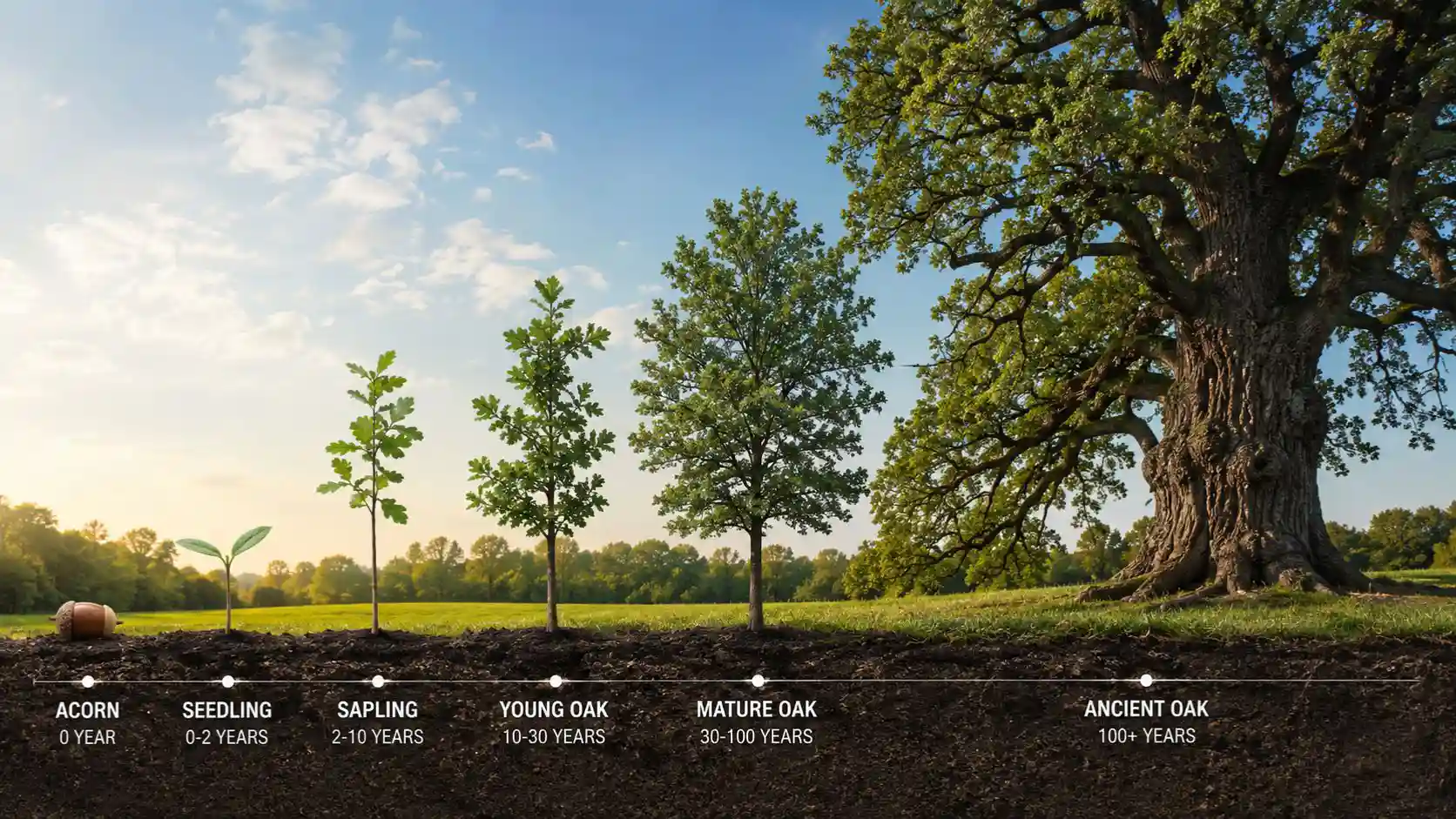
| Life Stage | Age Range | Key Characteristics |
| Acorn (Seed) | Germination Stage | Falls in autumn and undergoes winter cold stratification. In spring, the root emerges first, followed by the shoot. |
| Seedling | 0–2 Years | Focuses on developing a deep root system. Most vulnerable stage, with threats from drought, deer, and rodents. |
| Sapling | 2–10 Years | Rapid upward growth begins, branches develop, and bark starts changing texture as the tree matures. |
| Young Adult | 10–30 Years | Height and trunk growth accelerate, canopy expands, and acorn production typically begins around 20–25 years. |
| Mature Tree | 30–100 Years | Develops a broad canopy, thick trunk, and furrowed bark. Growth slows while ecological value reaches its peak. |
| Ancient Oak | 100+ Years | Can live 500–600 years in ideal conditions. Even aging trees provide valuable habitat for wildlife and support local ecosystems. |
White Oak Growth Rate vs. Red Oak Growth Rate
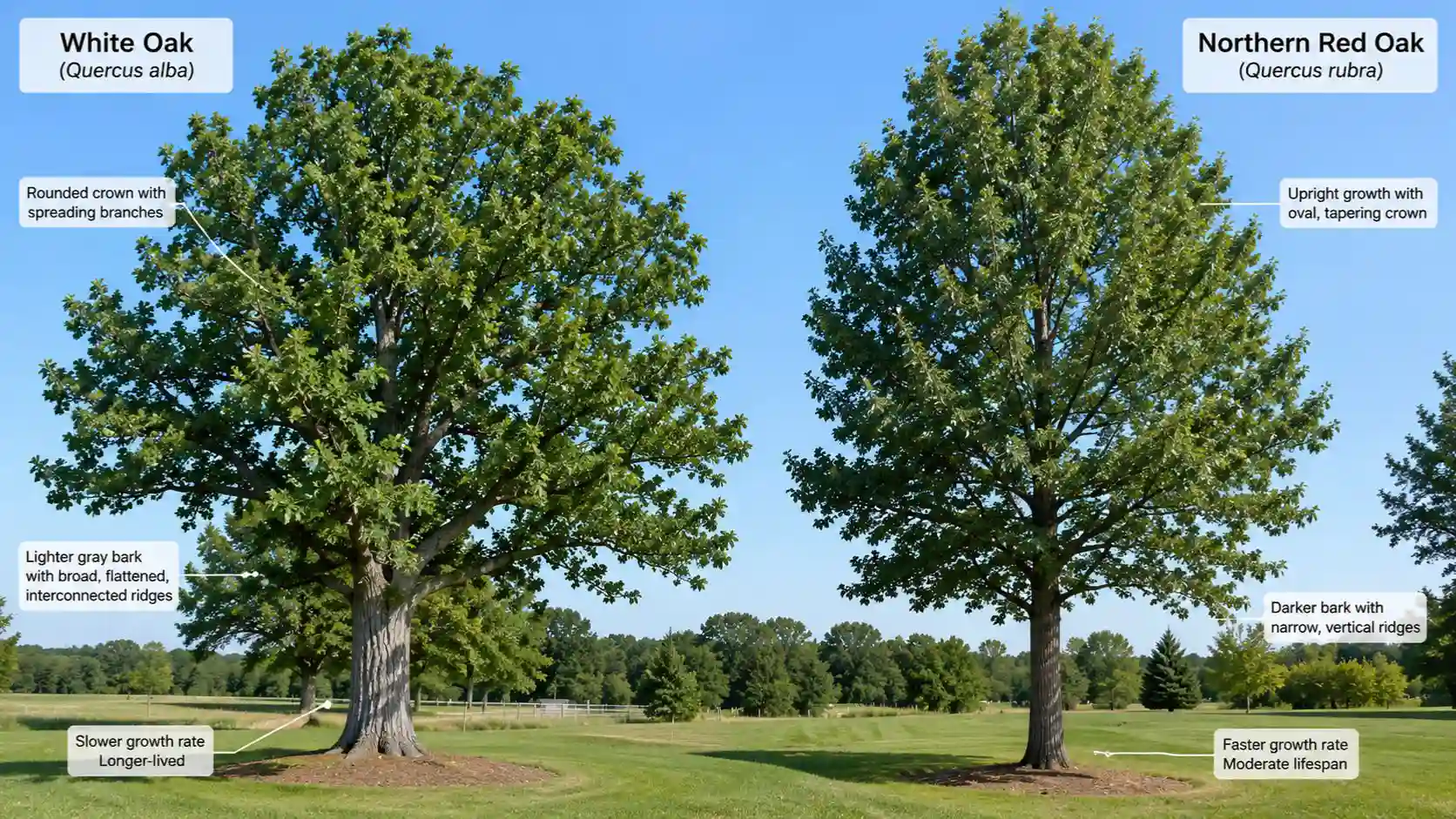
White Oak grows 1 to 2 feet per year and takes 50 to 100+ years to reach full size. According to the University of Kentucky Forestry Extension, white oak is considered the most important hardwood tree species in the eastern United States, valued for carbon sequestration, timber quality, and its role as a keystone species. It produces bumper acorn crops only every few years as a biological strategy to ensure some acorns survive past wildlife consumption.
Red Oak (Northern Red Oak) grows slightly faster at 1 to 3 feet per year, reaches maturity in 60 to 80 years, and produces acorns on a two-year cycle. It’s a better choice if you want faster shade, but white oak rewards patience with incomparable longevity.
For property owners in Texas who need meaningful canopy coverage sooner, faster-growing landscape trees can fill that gap while a slower oak matures alongside them.
Factors That Affect How Fast an Oak Tree Grows
Soil Quality: According to the University of Maryland Extension, white oak performs best in acidic soils below pH 6.5, and sapling growth is noticeably slower even in full shade, underscoring how critical both soil chemistry and light are in the early years.
Sunlight: Full sun (6+ hours daily) is critical for fast, healthy growth. Shade slows oaks considerably and they can survive it, but they won’t thrive.
Water: Young oaks need regular watering (1 inch per week) for the first 2 to 3 years. Once established, most species are drought-tolerant, but adequate rainfall promotes faster growth.
Climate and USDA Zone: Most oak species grow best in USDA zones 3 to 9, but the ideal zone varies by species. Northern red oak thrives in zones 3 to 8. Live oak performs best in zones 7 to 10.
Starting Method: Starting with a nursery-grown tree rather than an acorn gives you a 3- to 5-year head start, skipping the most fragile phase of growth.
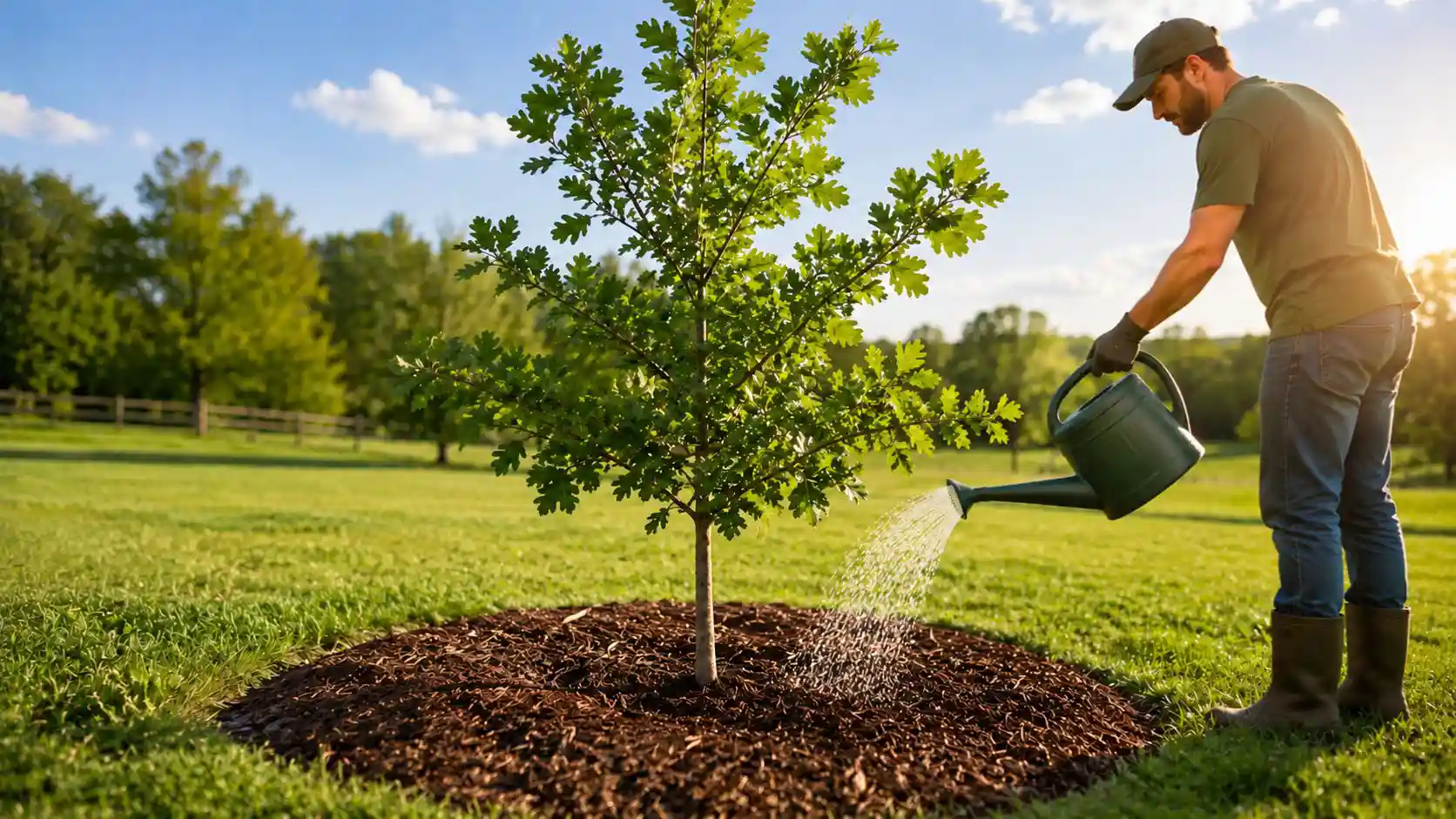
Mulching: A 3 to 4 inch layer of organic mulch around the base retains moisture, regulates soil temperature, and prevents grass competition, all of which noticeably improve growth speed.
Competition and Thinning: Research from the USDA Forest Service found that periodic thinning, beginning at age 30, can double board-foot yield over a rotation compared with unmanaged stands. Whether you call it tree trimming or tree pruning, applying the right technique at the right growth stage makes a measurable difference in how fast and structurally sound your oak becomes.
Moisture Availability: A USDA Forest Service dendrochronological study on white oak in Ohio found that May to July moisture levels were the single most important climate factor driving annual ring width, and trees in mesic sites showed significantly higher growth and biomass than those in dry sites.
How to Make an Oak Tree Grow Faster
Plant in the Right Location: Full sun, well-drained soil, away from heavy foot traffic. An oak planted in ideal conditions grows twice as fast as one in poor conditions.
Water Deeply and Consistently: In the first 3 years, deep and infrequent watering rather than shallow daily watering encourages the roots to grow downward, producing a more drought-tolerant and stable tree.
Mulch Generously: Spread a wide ring of wood chip mulch 3 to 4 inches deep around the base, kept away from the trunk to prevent rot. This retains moisture and suppresses competition.
Fertilize at the Right Time: A balanced, slow-release fertilizer applied during the best time for tree fertilization in early spring can meaningfully accelerate growth during the first 5 years. Avoid excessive nitrogen, which promotes rapid but structurally weak growth.
Prune Intentionally: Regular pruning of weak or crossing branches in the early years directs the tree’s energy toward the main trunk and structurally sound limbs, shaping how the oak grows for decades to come.
Plant Nursery Stock, Not Acorns: A 2 to 3-year-old nursery tree bypasses the most delicate and slow growth stages entirely and gives your oak a meaningful head start.
Common Mistakes That Slow Oak Tree Growth
Planting Too Deep
This is one of the most common and damaging errors. The root flare, which is where the trunk meets the roots, should sit at or just above soil level. Planting too deep suffocates the roots, restricts oxygen exchange, and silently stunts the tree for years before the damage becomes visible.
Overwatering After Establishment
Many people continue heavy watering routines well past the establishment phase. Mature oaks prefer dry to moderate conditions and can develop root rot in consistently saturated soil. Once your oak is past its third year, shift to deep, infrequent watering only during prolonged dry spells.
Planting in Shade or Near Large Structures
Oaks are full-sun trees. Planting near buildings, fences, or under an existing canopy limits the sunlight needed for strong annual growth. It can also cause the tree to grow asymmetrically as it leans toward available light, creating structural weakness over time.
Ignoring Soil pH
Planting in the wrong soil chemistry is a slow-motion growth killer. As Penn State Extension highlights, oaks planted outside their preferred pH range frequently underperform and may decline over time, with iron chlorosis being one of the most visible and common warning signs.
Missing Early Warning Signs
Yellowing leaves, sparse canopy, early leaf drop, and bark dieback are often misread as normal aging when they’re actually signs your tree is dying and needs attention. Root damage, soil compaction, disease, and drought stress are among the most common causes of tree death that go undetected until it’s too late, yet all of them are manageable when identified early.
Frequently Asked Questions
How long does it take for an oak tree to grow to full size?
Depending on the species, 50 to 100 years for full height. However, a useful shade tree can be achieved in as little as 15 to 25 years.
How big is a 10-year-old oak tree?
A 10-year-old oak tree is typically 10 to 20 feet tall, depending on the species, soil conditions, sunlight, and water availability.
How fast can an oak tree grow?
Most oak trees grow 1 to 3 feet per year during their active growth stage, though growth rates vary by species and environment.
How tall is a 2-year-old oak seedling?
A healthy 2-year-old oak seedling is usually 1 to 3 feet tall, depending on the oak species and growing conditions.
How big will an oak tree get in 10 years?
In 10 years under good conditions, an oak can reach 15 to 25 feet in height with a canopy spread of 10 to 15 feet.
When do oak trees start producing acorns?
Most oaks begin producing acorns between 20 and 40 years of age. Production peaks between 50 and 80 years.
How long do oak trees live?
Most oak species live 150 to 300 years. White oak in optimal conditions can live 500 to 600 years, per Iowa State University Extension.
What is the fastest-growing oak tree?
Northern red oak, Shumard oak, and willow oak are among the fastest-growing, capable of 2 to 3 feet per year in ideal conditions.
Final Thoughts
Planting an oak tree is one of the most meaningful long-term investments you can make in your landscape. Yes, they grow slowly compared to poplars or willows, but that slow growth produces wood, structure, and ecological value that fast-growing trees simply cannot match.
Start with healthy nursery stock, choose the right species for your climate, give it sun and well-drained soil, and let time do the rest. At any stage of that journey, having a certified arborist assess your tree ensures every decision from planting depth to pruning timing is made with the oak’s long-term health in mind.
A few things you do today will matter more 50 years from now.