
If you’ve searched for red oak tree planting advice, chances are you found guides written for Northern Red Oak (Quercus rubra), a tree built for cold Midwest winters, not South Texas summers. That’s a problem, because planting the wrong “red oak” in San Antonio soil is one of the most common mistakes we see homeowners make, and it usually shows up two or three years later as a stressed, struggling tree.
This guide covers how to plant a red oak tree the right way for our region, using Texas Red Oak (Shumard Oak, Quercus shumardii, and Spanish Oak, Quercus buckleyi), the red oak varieties that actually thrive in Central Texas heat, alkaline soil, and drought conditions.
Why “Red Oak” Means Something Different in Texas
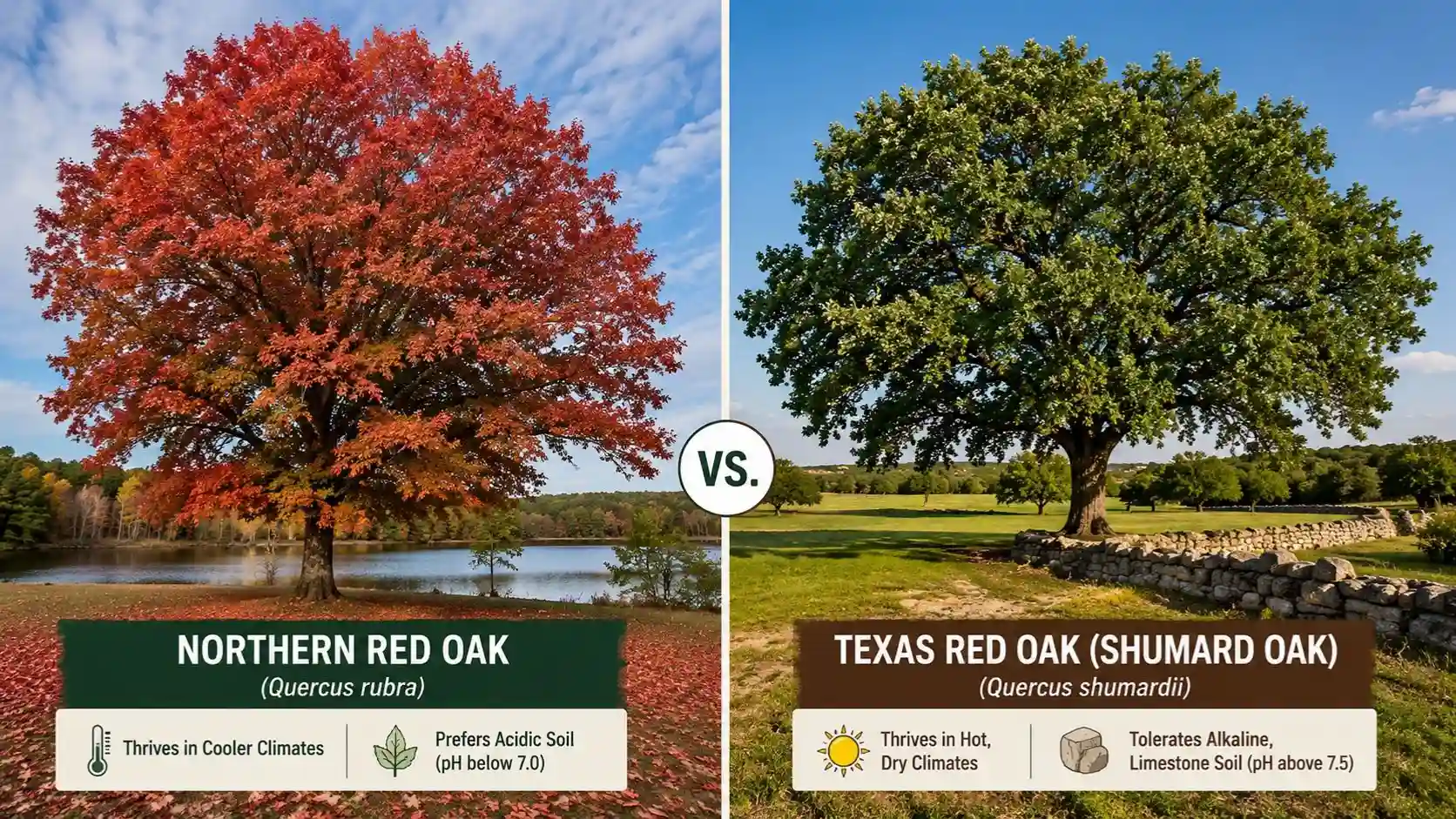
Most national planting guides assume you’re growing Northern Red Oak, which prefers acidic soil and cooler climates. Plant that tree in San Antonio’s clay-alkaline soil and triple-digit summers, and you’re fighting an uphill battle for its entire life. In alkaline soil, iron becomes chemically locked up and unavailable to tree roots, which is exactly the mechanism behind iron chlorosis in trees, according to Bexar County’s Texas A&M AgriLife Extension office, a condition that shows up as yellowing leaves and slowed growth in trees not suited to our soil.
Here’s how the three “red oak” species compare at a glance:
| Species | Alkaline Soil Tolerance | Mature Height | Mature Spread | Best For |
| Northern Red Oak (Quercus rubra) | Poor | 60-75 ft | 40-50 ft | Cold climates, zones 3-9, acidic soil |
| Shumard Oak (Quercus shumardii) | Excellent (pH 7.5+) | Up to 100 ft | 50-60 ft | San Antonio yards, large shade areas |
| Texas Red Oak / Spanish Oak (Quercus buckleyi) | Excellent | 30-40 ft | 25-35 ft | Smaller lots, Hill Country landscapes |
Texas A&M Forest Service’s Texas Tree Selector confirms Shumard Oak specifically tolerates alkaline soils with a pH above 7.5, along with drought and poorly drained sites, making it one of the best-adapted large shade trees for our region. It’s a fast grower too, capable of adding up to 2.5 feet of height per year, which puts it well ahead of how long oak trees take to grow on average compared to other oak species.
Both Texas-adapted varieties give you the same fast growth, strong shade canopy, and brilliant red-orange fall color people are usually picturing when they search for a “red oak,” without the long-term health problems of planting a species that doesn’t belong here.
If you’re weighing oak varieties for your yard more broadly, how Shumard compares to Live Oak, Bur Oak, and other Texas natives is worth understanding before you commit. And if fast-growing shade is your main goal, Texas Red Oak’s spot among the fastest-growing trees for Texas landscapes makes it hard to beat.
Best Time to Plant Red Oak Trees in Texas
The best time to plant red oak trees in Central Texas is during dormancy, from late fall through late winter (November through February). This gives the root system months to establish before the tree has to cope with summer heat and the demands of new leaves. This timing lines up with San Antonio’s broader planting zone guidelines, which account for our specific frost windows and growing season.
Avoid planting in the peak of summer (June through August) whenever possible. If a nursery tree becomes available then, it can still be planted successfully. It will just need significantly more frequent watering through its first summer to survive the establishment period.
Step-by-Step: How to Plant a Red Oak Tree
1. Choose the Right Spot
Shumard and Texas Red Oak both need full sun (at least 6 hours a day) and enough room to reach their mature spread. Before you dig, think ahead:
- Keep the tree at least 15 to 20 feet from your home’s foundation and other structures.
- Stay clear of underground utility lines. Texas law requires anyone digging, including homeowners planting a tree in their own backyard, to contact Texas811 at least two business days beforehand. It’s free and required by law.
- Avoid planting directly under power lines given the tree’s eventual height.
2. Dig the Hole Correctly
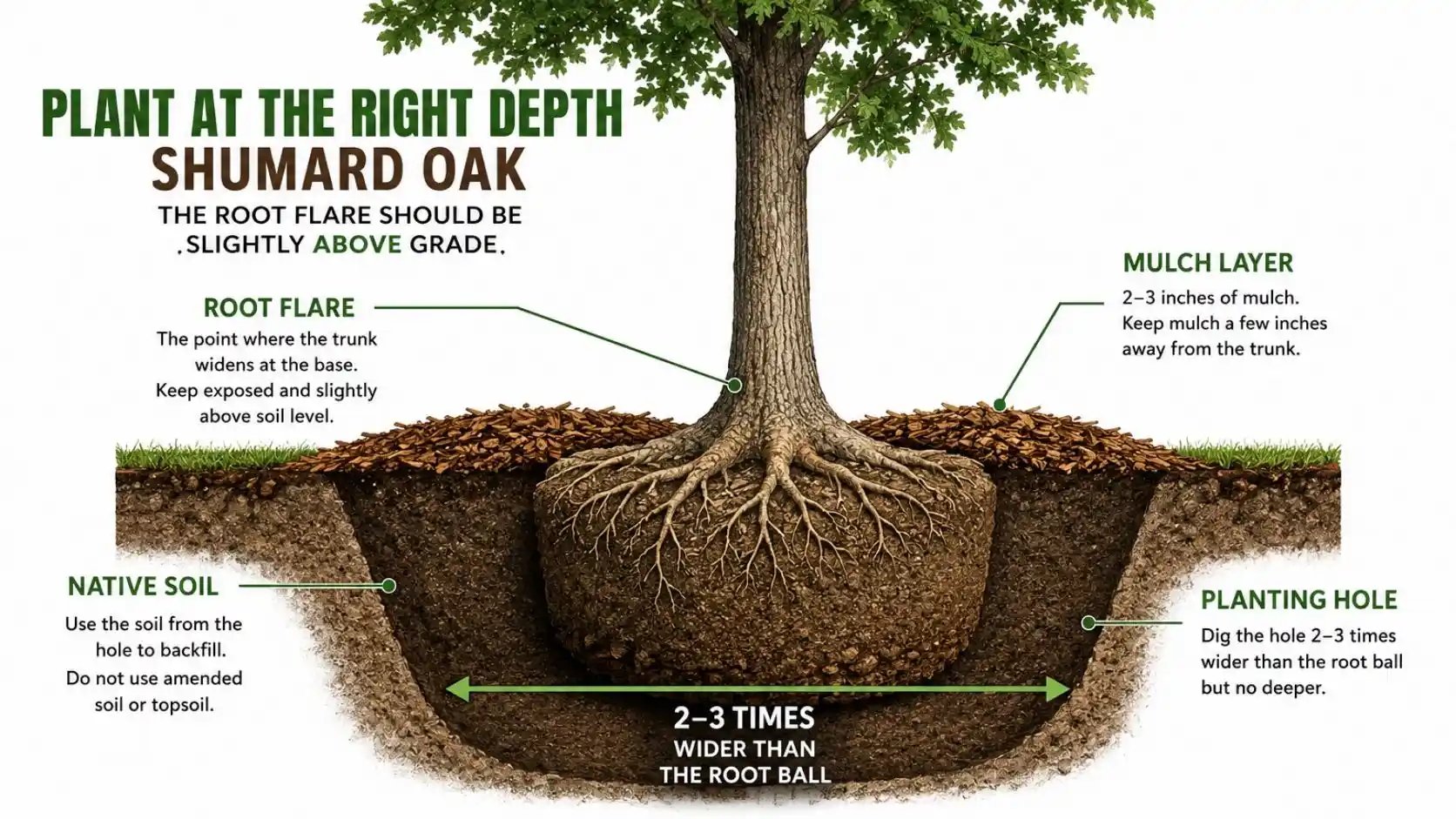
This is where most DIY plantings go wrong. Dig the hole 2 to 3 times wider than the root ball, but no deeper than the root ball itself. The goal is to keep the root flare (where the trunk widens at the base) slightly above the surrounding soil line once planted.
This isn’t just a rule of thumb. Research published in the ISA journal Arboriculture & Urban Forestry found that trees planted with their root flare buried even 6 inches below grade had significantly reduced survival rates and higher rates of girdling root formation compared to trees planted at grade, with some species showing 50% mortality within two years of deep planting. Getting this one step right matters more than almost anything else on this list.
3. Loosen and Inspect the Roots
If your tree came in a container, gently loosen circling roots around the edges of the root ball before placing it in the hole. Girdling roots that aren’t corrected at planting time can strangle the tree years later.
4. Backfill with Native Soil
Resist the urge to backfill with heavily amended soil or bagged topsoil. Using native soil helps the roots adapt to your actual yard conditions instead of creating a “container effect,” where roots circle inside a pocket of soft soil instead of spreading outward into the surrounding clay.
5. Water Deeply at Planting
Water thoroughly right after planting to settle the soil and eliminate air pockets around the roots. This first deep watering matters more than people expect. It’s often the difference between a tree that establishes well and one that struggles from week one.
6. Mulch Correctly
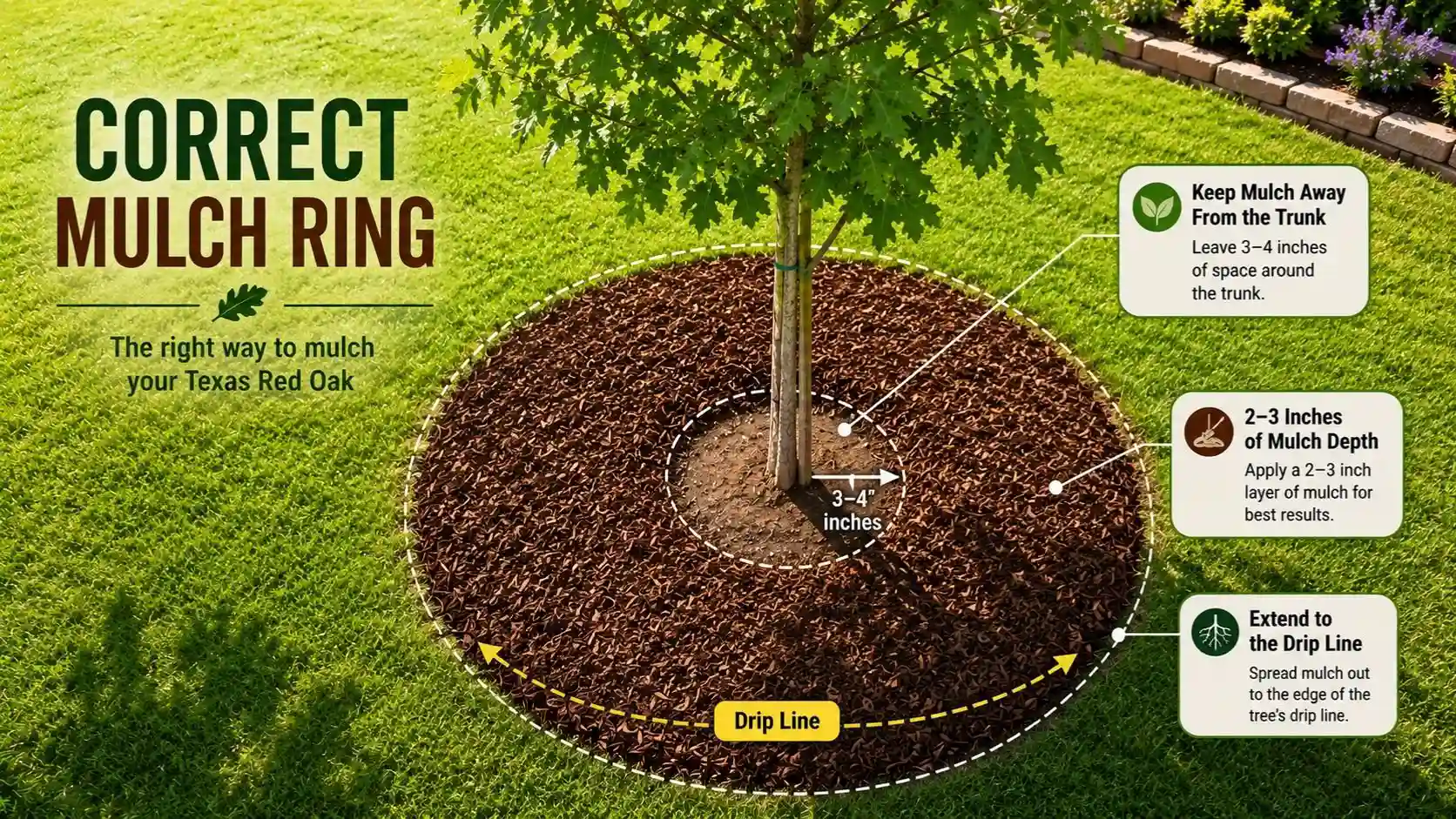
Apply 2 to 3 inches of mulch in a ring around the base, extending out to roughly the tree’s drip line. Keep mulch a few inches away from direct contact with the trunk to prevent rot and pest issues.
7. Stake Only If Necessary
Most container or B&B (balled and burlapped) red oaks don’t need staking. If your site is windy or the tree is top-heavy, stake loosely for no more than one growing season, then remove. Permanent staking weakens trunk development.
How Far Apart Should Red Oak Trees Be Planted?
Spacing depends on what you’re planting for and which species you’re using:
| Planting Purpose | Shumard Oak Spacing | Texas Red Oak Spacing |
| Shade or specimen tree | 35-45 ft apart | 25-30 ft apart |
| Natural grove or windbreak | 20-25 ft apart | 15-20 ft apart |
| From house or structure | 15-20 ft minimum | 12-15 ft minimum |
| From driveways, sidewalks, utility lines | 8-10 ft minimum | 8-10 ft minimum |
Shumard Oak needs more room given its potential 60-foot spread at maturity, while Texas Red Oak (Spanish Oak), being smaller at maturity, can be spaced slightly closer if you’re planning a tighter grouping.
Caring for Your Red Oak in the First Year
The first 12 to 24 months determine whether your tree establishes strong roots or struggles long-term.
- Watering: new plantings need consistent moisture. Water deeply 2 to 3 times per week for the first few months, tapering to once a week through the first summer.
- Fertilizing: hold off on fertilizer the first year. Newly planted trees need to focus energy on root establishment, not top growth. Once your tree is established, you can shift to a routine built around tree fertilization best times and methods, feeding it on a schedule that supports steady growth.
- Pruning: only remove dead, damaged, or crossing branches in year one. Structural pruning can wait until the tree is established, usually two to three years in. At that point, regular tree pruning keeps its structure sound without putting unnecessary stress on the tree.
Common Mistakes to Avoid
- Planting Northern Red Oak instead of Shumard or Texas Red Oak, the single biggest mistake for this region.
- Planting too deep, burying the root flare, one of the leading causes of premature tree decline documented in arboriculture research.
- Overwatering in heavy clay soil, which suffocates roots and invites rot, one of several common causes behind why trees die that homeowners often overlook.
- Amending the backfill soil too heavily, encouraging roots to circle instead of spread.
- Staking too tightly or leaving stakes on too long, which weakens trunk strength.
Frequently Asked Questions
1. How do you plant a red oak tree?
Dig a hole 2 to 3 times wider than the root ball but no deeper, keep the root flare slightly above soil level, backfill with native soil, water deeply, and mulch 2 to 3 inches around the base without touching the trunk.
2. How do you plant a red oak tree in Texas specifically?
Follow the same core steps, but choose Shumard Oak or Texas Red Oak instead of Northern Red Oak, since they handle our alkaline soil and heat far better.
3. How far apart should red oak trees be planted?
Space Shumard Oaks 35 to 45 feet apart as shade trees. For tighter groupings or Texas Red Oak, 25 to 30 feet apart works well.
4. How far apart should you plant red oak trees from your house?
Keep at least 15 to 20 feet between the tree and your home’s foundation to protect against future root and structural issues.
5. How deep should you plant a red oak tree?
No deeper than the root ball. The root flare should sit at or just above soil level.
6. Can you grow a red oak tree from an acorn?
Yes, but it takes longer to reach a full size than starting with a nursery tree.
7. How long does it take for a red oak tree to grow to full size?
Shumard Oak grows up to 2.5 feet a year and reaches maturity in about 30 to 40 years.
8. Does a red oak tree need full sun?
Yes, at least 6 hours of direct sun a day for healthy canopy growth.
Conclusion
Planting a red oak tree is a long-term investment in your property’s shade, curb appeal, and value, but only if you start with the right species for your climate. In San Antonio, that means choosing Shumard Oak or Texas Red Oak over the Northern Red Oak most generic guides describe, and following proper planting depth, spacing, and watering practices from day one. Get these fundamentals right, and you’ll have a healthy, thriving shade tree for decades to come.
If you’d rather skip the guesswork, our certified arborists at Tree Amigos Tree Service can help you select the right red oak variety for your soil and space, and handle the planting for you. Contact us today for a consultation.